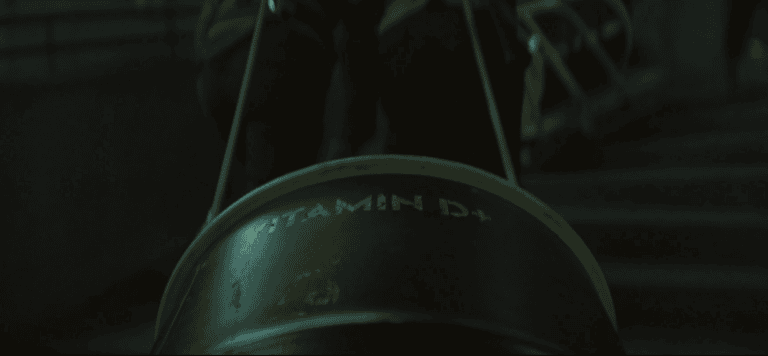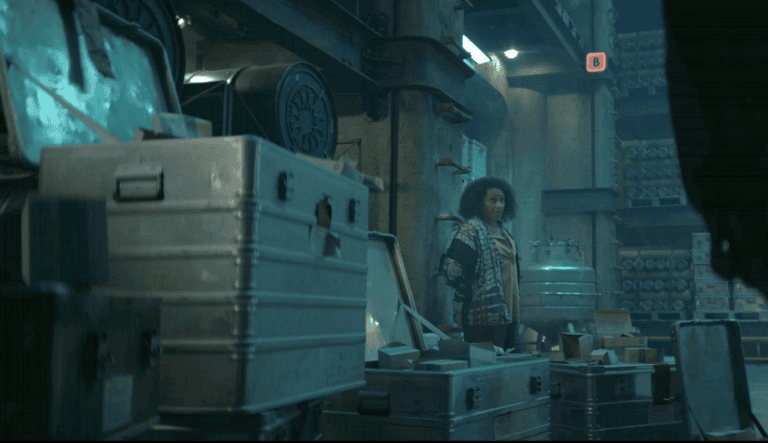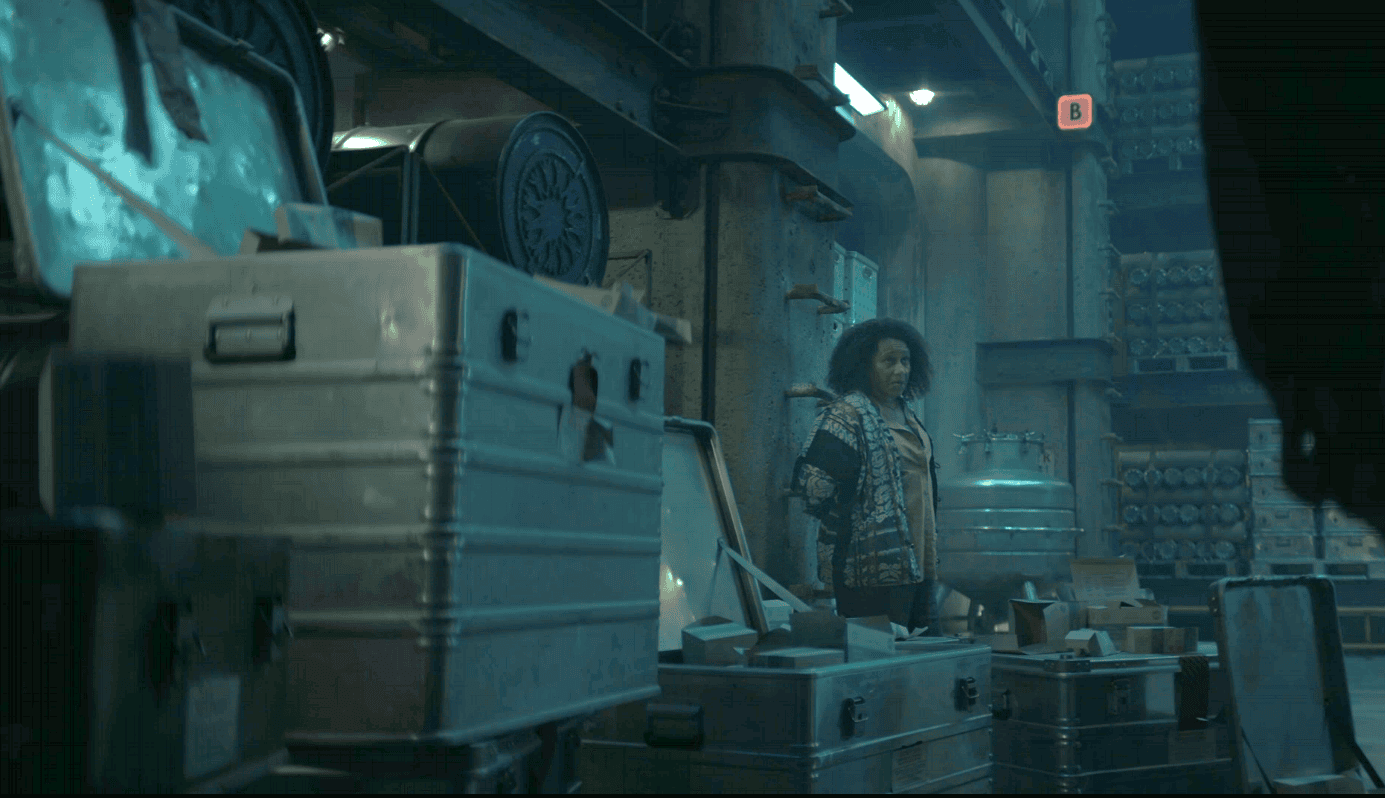
The investigation reaches Critical Supply, where empty storage cases reveal that Silo 18 may have only two years of replacement farm bulbs left.
Billings discovered that decades of irreplaceable agricultural bulbs have been stolen from Critical Supply, leaving Silo 18 with approximately two years of replacements. That means Juliette could stop the Safeguard and save everyone from the Voice, only for the silo’s farms—and eventually its entire population—to die anyway.
Watch the full breakdown below, then keep reading for the deeper analysis of Billings’ investigation, the missing farm bulbs, and what the two-year deadline could mean for the future of Silo 18.
What Did Billings Discover in Silo Season 3 Episode 5?
Billings discovered that someone has systematically removed the replacement bulbs required to keep Silo 18’s farms operating.
Critical Supply was supposed to contain decades of agricultural bulbs. Instead, Carla shows Billings that most of the boxes are empty. Based on the remaining inventory, the silo has approximately two years before it begins running out of replacements.
The bulbs may sound like ordinary equipment, but they provide the artificial light required to grow food underground. Once the remaining bulbs fail, the crops begin failing with them. The generator can continue running, Judicial can continue enforcing the Pact, and everyone can keep reporting to work, but none of those systems can replace the food produced by the farms.
This changes the entire survival equation for Silo 18.
At the end of Episode 5, Juliette finally remembers what Solo’s parents did in Silo 17. They reached the pipe beneath the silo, capped it, and stopped the substance associated with the Safeguard from entering.
Reaching that pipe will not be easy, but Juliette now knows that the immediate threat has a physical solution.
Get below Silo 18. Find the pipe. Block it.
Billings’ discovery does not come with that kind of answer.
He does not know where the missing bulbs went, whether they are still usable, how many people were involved, or why anyone would knowingly steal equipment required for their own survival.
Juliette may have found a way to stop one death sentence while Billings uncovered another.
How Orla’s Murder Led Billings to Critical Supply
Billings enters Episode 5 investigating Orla’s murder without knowing why anyone wanted her dead.
Orla was struck from behind. Her body was moved away from the original murder scene and left inside a restricted section of the mines where almost no one was expected to find her.
Billings also learns that Orla’s boyfriend was previously involved with Glenda, Carla’s former Supply shadow. His reaction to Orla’s death is cold enough for Billings to notice, but that alone does not prove he killed her or that Glenda used him to watch Orla.
The motive begins taking shape when Carla returns to Supply.
Billings tells Carla that Orla was murdered, and Carla immediately blames herself. She reveals that Orla had been helping her investigate inventory disappearing from Supply.
Carla had replaced Glenda with Orla because she needed someone she believed she could trust. Orla came from a Supply family, understood the department, and had access to the records needed to compare what the paperwork claimed against what was actually sitting on the shelves.
That investigation eventually leads Billings into Critical Supply.
This is not ordinary inventory. Critical Supply contains original equipment stored when Silo 18 was constructed. Some of those items cannot be manufactured inside the silo. Once they are used, broken, or stolen, there is no simple way to replace them.
Removing anything from the room also requires three approvals, including authorization connected to the head of Supply or the Supply shadow.
That means the bulbs did not disappear because one person casually carried a box home.
Someone with access either approved the movement, falsified the records, or found a way around a system specifically designed to protect equipment the silo cannot reproduce.
Orla was in a position to identify which supplies were missing, when they disappeared, and who had access when the inventory changed.
If she found the person directing the operation—or the route being used to move the equipment—she could have exposed everything to Carla, Billings, or the council.
That gives someone a clear reason to silence her.
Why the Missing Farm Bulbs Are a Death Sentence
Silo 18 survives because its major systems depend on one another.
The generator supplies power. Mechanical keeps the machinery operating. Medical treats the population. Supply distributes equipment. The farms produce the food required to keep all 10,000 residents alive.
The farms cannot operate underground without artificial light.
When a bulb fails, it must be replaced. Silo 18 cannot simply manufacture another one, and Critical Supply was supposed to contain enough replacements to last for decades.
Someone has taken most of them.
Carla’s estimate does not necessarily mean every farm goes dark exactly two years from now. It means the remaining replacement supply will begin running out around that point. Afterward, every failed bulb becomes another section of farmland that may lose the light required to grow crops.
The food crisis could begin gradually, but the ending remains the same unless the silo finds more bulbs or another source of food.
That is why the theft is larger than Orla’s murder.
Billings started by trying to identify one killer. He leaves Critical Supply knowing someone has placed the entire population on a countdown.
The theft has already removed decades from Silo 18’s expected future.
Why a Normal Black Market Does Not Fully Explain the Theft
Silo 18 clearly has an unofficial economy.
People steal supplies, move relics, trade restricted equipment, and use hidden routes. It is possible that some of the missing Critical Supply inventory was sold or distributed through that network.
But a normal black-market explanation does not fully account for decades of specialized agricultural bulbs.
These bulbs have limited personal value. A resident cannot use enough of them inside an apartment to justify stripping Critical Supply almost empty. More importantly, the thieves also depend on the farms.
If the bulbs disappear and the crops fail, the people profiting from the theft eventually starve alongside everyone else.
That creates the central contradiction of Billings’ discovery:
Someone stole equipment required for their own survival.
The person directing the operation may believe Silo 18 will not remain inhabited long enough for the shortage to matter. They may expect a selected group to be somewhere else before the bulbs run out. They may also believe another hidden project is more important than preserving the silo in its current form.
The theft therefore looks less like casual resale and more like preparation.
The exact purpose remains unconfirmed, but the scale suggests coordination.
Are the Missing Bulbs Being Used in the Mines?
Orla’s body being placed in the mines makes an underground operation difficult to ignore.
A hidden farm would require sustained lighting. A tunnel or unauthorized settlement would require equipment, power, supplies, and a concealed route for moving materials without creating official records.
The stolen bulbs could support one of those projects.
That does not mean Episode 5 proves the bulbs are installed underground. No scene shows them inside a hidden farm or tunnel. The mines may have been chosen only because the closed section provided an isolated place to hide Orla’s body.
However, several pieces of the story now point in the same direction.
The Harwood family has influence in the mines. Orla’s boyfriend has a past connection to Glenda. Glenda previously held one of the positions capable of accessing Critical Supply. Orla was investigating missing inventory, and her body was moved into a restricted underground location.
Billings now has to determine whether those connections belong to one coordinated operation or several unofficial networks overlapping inside Silo 18.
Carla helped Sims move Bernard into the digger void, but that does not automatically mean she knew about the missing bulbs. Different groups may be using Supply for different reasons.
One operation may be resisting the Voice.
Another may be sacrificing the future of the population.
Billings must now separate them.
How the Theft Connects to the 200-Foot Mining Rule
The Pact restricts how far residents can mine horizontally.
That rule originally sounds like a safety regulation, but the surrounding silos are close enough that unrestricted digging could eventually create contact between them.
Episode 3 established that the Voice treats inter-silo contact as an immediate Safeguard risk. That gives the mining restriction a second purpose: keeping each silo physically isolated from the others.
If someone has been stealing bulbs and other equipment to support an unauthorized tunnel, the project could be attempting to reach another silo.
That would explain why secrecy matters more than preserving Silo 18’s long-term supply.
The people behind the project may believe that remaining inside Silo 18 is no longer a viable future. They could be preparing an escape route, building a separate survival location, or trying to establish contact outside the system controlled by Silo 1.
None of those explanations is confirmed yet.
What Episode 5 confirms is that someone knowingly accepted the risk of future starvation to support whatever they were doing.
Why Silo 17 May Become a Source of Supplies
Bernard also reveals that all 50 silos possess radio equipment.
Silo 18 has not heard the others because its residents have been listening to the wrong channels, while Silo 1 monitors the frequencies being used across the network.
Before Billings’ discovery, contacting another silo primarily mattered because it could expose the truth about the larger system.
The missing bulbs give Silo 18 a practical reason to make contact.
If the silo cannot manufacture replacement equipment, the nearest possible source may be another silo that still has it.
Silo 17 is nearly empty after most of its population died outside. Its lower levels are flooded, and the condition of its farms, power, water, living areas, and Critical Supply storage remains uncertain.
That means relocating all 10,000 residents would be an enormous and possibly impossible task.
But Silo 17 may still contain equipment its dead population no longer needs.
A smaller team could potentially return for agricultural bulbs, tools, medical supplies, suits, good heat tape, or original Day One equipment. Moving supplies would be far easier than moving the entire population.
The radio discovery could help Juliette, Walker, Lukas, and the others coordinate that kind of mission.
If Silo 17 cannot provide enough replacement equipment, the shortage may eventually force Silo 18 to reach farther into the network.
Which silos are still alive?
Which ones have supplies?
Can equipment be moved between them without Silo 1 intervening?
Those questions already existed, but Billings has now given the characters a deadline for answering them.
Why Billings’ Discovery Matters More Than the Safeguard
The Safeguard remains an immediate threat.
The Voice can still order it. Juliette still has to reach the pipe, and the system will not allow her to block it without resistance.
But Episode 5 has transformed the Safeguard from an unknown threat into a mission with a possible solution.
The missing-bulb crisis has no confirmed solution.
That makes Billings’ discovery capable of driving the story even after Juliette deals with the pipe.
The two threats now control different parts of Silo 18’s future.
The Safeguard determines whether the population survives the Voice’s next attack.
Critical Supply determines whether the population has a future afterward.
The person who stole the bulbs may already be acting on information Billings does not have. They may believe Silo 18 is doomed, be preparing another location for a smaller population, or know something about the remaining life of the silo that has not been revealed.
The exact motive is still open.
The consequence is not.
Stopping the Safeguard now saves Silo 18 from dying immediately. It does not restore the decades of survival equipment someone has already taken away.
What the Episode 4 Poll Got Right—and Missed
In the Episode 4 poll, 54 percent chose Sims secretly switching sides as the moment most likely to matter in Episode 5.
That became the strongest immediate answer. Sims gave Juliette the PEZ dispenser, helped break through the false memories surrounding her, and put her on the path toward remembering what happened in Silo 17.
Another 41 percent chose Juliette finding Bernard alive. Bernard provided the information that helped Sims understand the system and eventually helped Juliette recover the memory of Solo’s parents blocking the pipe.
Only 5 percent chose Daniel and Helen accepting the offer. That storyline may still contain a larger clue about the nanocloud, Per Stenson, the USS Nimitz, and whether the apparent missile attack was actually the delivery method.
No one chose Billings proving Orla was murdered.
That ended up being the most important option for this video.
The murder pushed Billings toward Carla, the Supply investigation, the empty boxes, and the revelation that Silo 18 may have only two years of replacement bulbs remaining.
The moment that received zero percent may have opened the next major survival conflict.
What Billings’ Discovery Means for Episode 6 and Beyond
Billings is now following the same trail that may have gotten Orla killed.
He can connect Glenda to Critical Supply. He can connect the Harwoods to the mines. He can connect Orla’s boyfriend to both women. As sheriff, he also has the authority to ask questions Orla may have been forced to investigate quietly.
That makes him dangerous to whoever is directing the theft.
However, solving the murder may not recover the bulbs.
They could already be installed, damaged, distributed across the silo, or moved into a location Billings cannot reach. Finding them may require Juliette, Lukas, Walker, Kennedy, Sims, Carla, and the Outsiders to combine what they know.
Episode 5 appears to be closing one major loop while opening another.
Juliette remembers the pipe and gains a possible solution to the Safeguard.
Billings opens Critical Supply and discovers a second extinction clock that continues counting down even after the pipe is blocked.
That is why this reveal may become the larger story engine moving toward the final season. The characters can defeat the immediate plan of the Voice and still be forced to solve the mysteries surrounding the mines, Silo 17, radio communication, and the larger network simply to keep Silo 18 alive.
Final Takeaway
What Billings discovered changes everything because the missing agricultural bulbs prove that stopping the Safeguard will no longer be enough to save Silo 18.
Someone has stolen decades of irreplaceable equipment and reduced the farms’ remaining replacement supply to approximately two years. Whoever ordered the theft either does not expect Silo 18 to survive, expects to escape before the deadline, or believes another hidden project is more important than the lives currently depending on the farms.
Juliette can plug the pipe.
But Billings just found the clock that keeps counting down to zero even after she does.
Which Episode 5 moment do you think will matter most in Episode 6: Juliette remembering the pipe, Billings finding the two-year clock, Walker discovering the silo channels, or Daniel’s car being hijacked?
Article grounded in the finalized Episode 5 script and research inputs.
About the Author